
TL;DR: PBN Hosting vs. Shared Hosting
PBN hosting is designed to simplify the management and infrastructure distribution of multiple websites, while shared hosting provides general-purpose hosting on resources used by multiple customers. Neither hosting type automatically improves SEO.
I would consider PBN hosting when managing several sites creates specific infrastructure and administrative requirements. For a conventional business website, blog or standalone project, a reputable shared hosting plan is usually the more practical starting point.
The important distinction is that hosting can affect a site’s performance, reliability and accessibility, but using different IP addresses or specialised PBN hosting does not, by itself, establish a Google ranking advantage.
| Comparison | PBN Hosting | Shared Hosting |
|---|---|---|
| Primary purpose | Managing multiple sites operated as a network | General-purpose website hosting |
| Infrastructure | May distribute sites across different servers, IPs or data centres | Multiple customer accounts use common server infrastructure |
| IP and DNS arrangements | May offer different IP ranges, DNS configurations or nameservers | Usually determined by the provider and plan |
| Resource allocation | Depends on the service and underlying infrastructure | Shared or allocated according to the plan |
| Multi-site management | Often a central feature | Varies by provider and plan |
| Cost | Can cost more because of specialised management features | Often has a lower entry price |
| SEO advantage from the hosting label | No guaranteed ranking advantage | No inherent SEO disadvantage |
| Best suited to | Specialised multi-site management requirements | Conventional standalone websites |
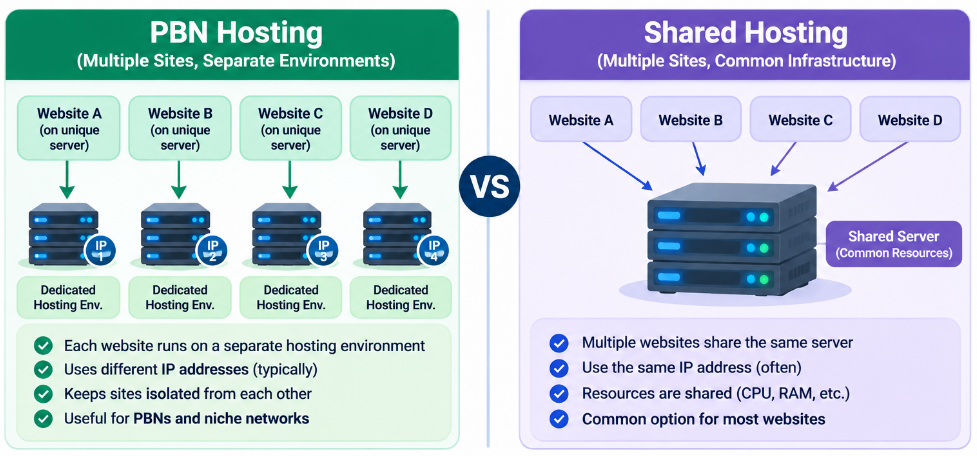
What Is the Difference Between PBN Hosting and Shared Hosting?
The main difference between PBN hosting and shared hosting is how the services are designed to manage websites and infrastructure. PBN hosting focuses on multi-site administration and infrastructure distribution, while shared hosting is intended to make website hosting accessible and economical.
If you’re comparing PBN hosting vs. shared hosting for SEO, it helps to separate the hosting arrangement from the SEO strategy behind the websites. IP addresses, DNS configurations and nameservers describe parts of the technical setup. They do not, on their own, demonstrate that a site will rank better.
What is PBN hosting?
PBN hosting is specialised hosting intended to help manage multiple websites operated as part of a private blog network, sometimes with sites distributed across different infrastructure.
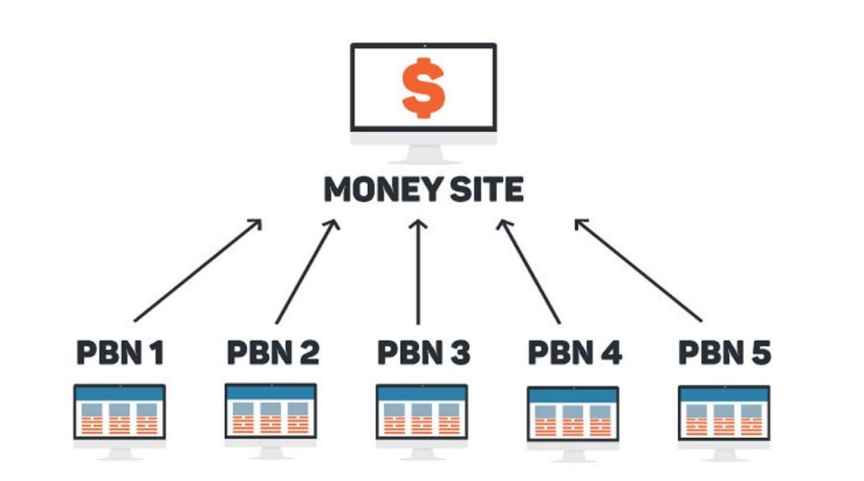
Depending on the service, websites may be placed on different IP ranges, servers, data centres or DNS configurations. Some platforms also provide a central dashboard for WordPress installation, backups, updates and other routine tasks.
Those features can make a multi-site setup easier to administer. However, I would not treat infrastructure distribution as proof of an SEO benefit or a guarantee that a network is undetectable.
If you’re unfamiliar with the underlying strategy, read more about what PBN SEO means.
What is shared hosting?
Shared hosting places multiple websites or customer accounts on common server infrastructure, with resources shared or allocated according to the hosting provider’s configuration and plan limits.
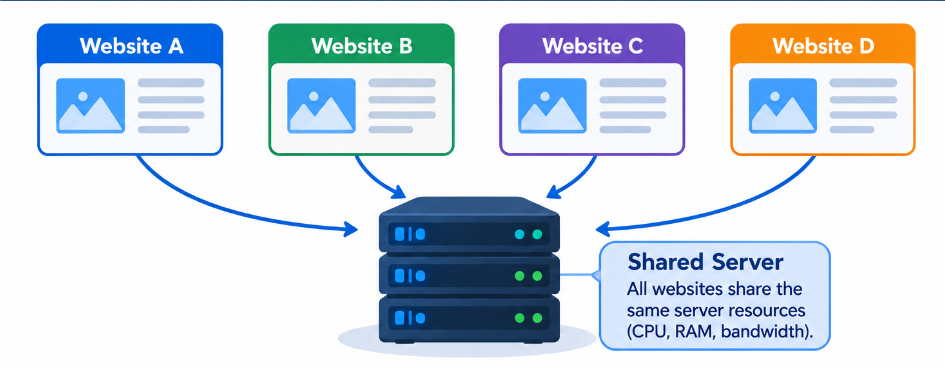
It is designed for general website hosting rather than specialised network management. A shared hosting plan may support a business website, blog, portfolio or several smaller websites, depending on its account and resource limits.
The quality of shared hosting varies. CPU and memory limits, storage, caching, server load, account isolation, security and support all depend on the provider and plan.
For a standalone website, I would assess those practical details rather than assume that shared hosting is unsuitable for SEO.
Does PBN Hosting Have an SEO Advantage Over Shared Hosting?
There is no established ranking advantage from choosing a hosting service simply because it is labelled PBN hosting. The more useful SEO considerations are performance, reliability, crawl accessibility, content quality and compliance with search-engine policies.
Google’s spam policies identify links created primarily to manipulate search rankings as link spam. Changing the hosting provider, IP address or DNS configuration does not change the purpose of links placed to manipulate rankings.
This distinction is important. PBN hosting may change how websites are deployed and administered, but it cannot make a policy-violating linking practice compliant just by distributing the infrastructure.
Do different IP addresses improve Google rankings?
A different IP address does not automatically improve a website’s Google rankings. IP diversity is an infrastructure choice, not a guaranteed ranking factor.
A shared IP can legitimately serve many unrelated websites. Likewise, two websites using different IP addresses may still rely on the same hosting company, account owner, management platform or wider infrastructure.
For that reason, I would avoid judging hosting quality or SEO potential by IP count alone. If a provider advertises multiple IP addresses, check what that arrangement actually means rather than assuming it establishes complete infrastructure independence.
Can shared hosting create a PBN footprint?
Using shared hosting does not automatically create an SEO problem, but placing multiple related websites on the same account or infrastructure can create obvious operational commonalities. Those commonalities should not be confused with proof of a specific Google detection mechanism.
A hosting arrangement can reveal technical relationships, such as shared nameservers, IP addresses or server infrastructure. However, observing a common technical detail is not the same as proving that Google uses that detail alone to identify a private blog network or determine rankings.
The wider context matters. Ownership, linking patterns, site purpose and the quality of the websites are separate considerations. I would therefore be cautious about both extremes: claims that a shared IP automatically causes a penalty and claims that different IPs make a network invisible.
Does PBN hosting make a private blog network safe?
No hosting configuration can guarantee that a private blog network is safe from search-engine policy enforcement.
Google’s published spam policies explain that links created primarily to manipulate rankings can violate its link spam policy. A provider’s use of different IP ranges, DNS configurations or nameservers does not remove that risk.
Treat phrases such as “zero footprints”, “undetectable hosting” and “guaranteed SEO safety” as marketing claims unless the provider can substantiate exactly what it means—and even then, no provider can guarantee how a search engine will assess a site’s linking practices.
How Do Performance and Reliability Compare?
Neither PBN hosting nor shared hosting is automatically faster. Actual server resources, configuration, uptime and site optimisation determine the experience.
Shared hosting can experience resource contention because multiple customer accounts use common infrastructure. The practical impact depends on how the provider allocates resources and manages its servers.
PBN hosting can also perform poorly if the underlying servers are overloaded, underpowered or poorly maintained. Specialised management features do not guarantee good response times.
For SEO, I would focus on whether the website loads reliably and remains accessible to visitors and search-engine crawlers. Google’s Core Web Vitals provide useful measures of user experience, but good scores alone do not guarantee high rankings.
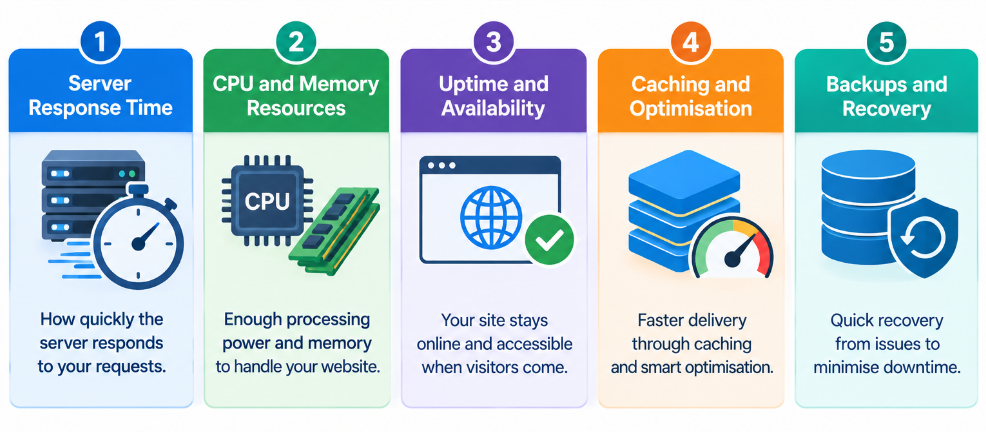
When comparing plans, look at:
- Server response and page performance: assess actual website performance rather than relying only on a provider’s speed claims.
- Resource limits: check CPU, memory, storage and process limits, particularly if several websites will run under one service.
- Uptime and availability: look for a clear uptime policy and a support process for outages.
- Caching and optimisation: check which server-level caching or performance features are included.
- Backups and recovery: confirm backup frequency, retention and whether you can restore a site yourself.
Where Does PBN Hosting Offer Practical Advantages?
The clearest advantage of specialised PBN hosting is operational convenience. It can make it easier to deploy, organise and maintain multiple websites that have separate infrastructure requirements.
Depending on the platform, a central dashboard may support WordPress installations, backups, updates, SSL certificates, monitoring and routine site administration. Managing the same number of websites through separate conventional hosting accounts can involve more manual work.
The value depends on the number of sites and the features included. If you only operate one ordinary website, specialised network-management features may add cost without solving a problem you have.
If you’re assessing the available management features, a PBN tools guide can help you understand the wider tools involved in managing a network.
Which Option Is More Affordable?
Shared hosting generally has a lower entry cost, while PBN hosting may charge more for specialised multi-site management and infrastructure arrangements. The better value depends on what you need to manage.
A conventional shared hosting account may be sufficient for one website or a small project, although the number of websites and available resources vary by plan.
PBN hosting may reduce the administrative effort involved in managing multiple sites across different infrastructure. However, the total cost should include more than the advertised starting price.
Before choosing, compare:
- The number of websites or installations included.
- Storage, CPU, memory and other resource limits.
- Whether IP addresses or infrastructure distribution incur additional charges.
- Backup frequency, retention and restore options.
- Migration, setup and support fees.
- Restrictions on plugins, software, site usage or account access.
- The cost of adding sites or increasing resources later.
I would calculate the cost against the number of websites you actually need to host. A cheaper plan is not necessarily better value if it creates resource limitations or requires substantial manual administration.
What Should You Choose: PBN Hosting or Shared Hosting?
For most conventional websites, I would choose a reputable shared hosting plan based on its performance, reliability, security, resources and support. PBN hosting is more relevant when managing multiple network sites creates specialised infrastructure and administrative requirements.
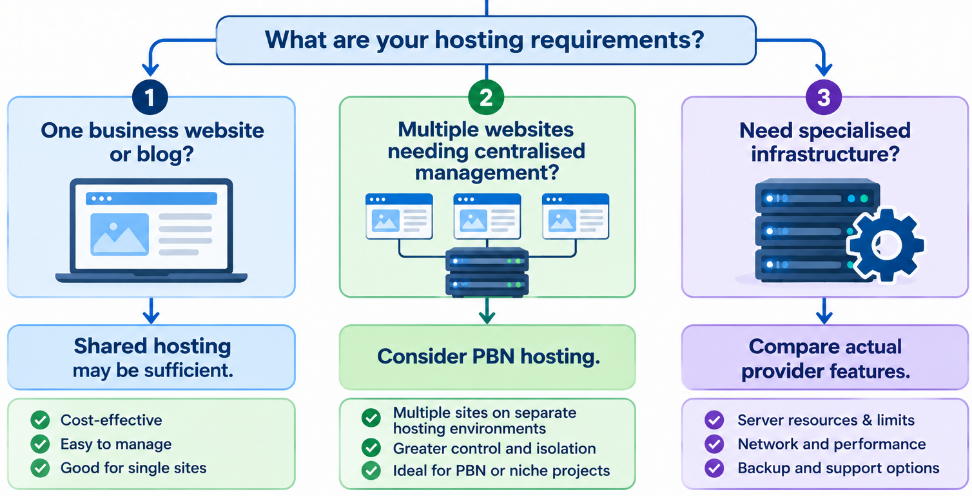
Choose shared hosting if:
- You are running a business website, blog, portfolio or standalone project.
- You do not need specialised multi-site network management.
- The provider offers sufficient resources and account controls.
- You want a straightforward hosting setup with a lower entry cost.
Consider PBN hosting if:
- You manage multiple websites and need centralised administration.
- You have specific infrastructure-distribution requirements.
- The provider’s management features save meaningful time.
- You have checked its resource limits, restrictions, support and total cost.
Neither option should be selected on the assumption that its hosting label will improve rankings. For a broader look at available services, you can compare PBN hosting providers after deciding which features your setup actually requires.
Conclusion: PBN Hosting vs. Shared Hosting
PBN hosting and shared hosting solve different operational problems; neither is inherently better for SEO.
For a normal standalone website, I would generally favour good shared hosting if it provides sufficient resources, speed, uptime, security and support. PBN hosting becomes more relevant when multiple websites need centralised management and specific infrastructure arrangements.
The important point is not whether a plan is marketed as PBN or shared hosting. Choose the environment that meets your technical requirements, and assess SEO separately through site quality, accessibility, performance and compliance with search-engine guidelines.
Frequently Asked Questions
Is PBN hosting better than shared hosting for SEO?
Not inherently. PBN hosting can provide specialised infrastructure and multi-site management, but the hosting category alone does not establish a ranking advantage. Performance, accessibility, content and linking practices matter separately.
Is shared hosting bad for SEO?
No. Shared hosting can be suitable for SEO when it provides adequate performance, reliability and crawl accessibility. I would judge the actual hosting environment rather than assume shared infrastructure creates an SEO disadvantage.
Does a shared IP address affect Google rankings?
There is no established rule that sharing an IP address automatically harms Google rankings. Many unrelated websites can legitimately use shared infrastructure, so a dedicated or unique IP should not be treated as an automatic SEO benefit.
Does every PBN website need a different IP address?
No general technical requirement says every website needs a different IP address to function or appear in search results. Different IP arrangements may be an infrastructure choice for network operators, but they should not be confused with a proven ranking requirement.
Can you host PBN sites on normal shared hosting?
Technically, websites used in a private network can run on conventional shared hosting if the provider permits the sites and their resource requirements are met. Specialised PBN hosting mainly changes how network infrastructure and management are handled.
Can Google detect a PBN through its hosting?
Google’s public documentation does not establish a simple hosting characteristic that determines PBN detection. Hosting information can expose technical relationships between sites, but I would avoid claims that one IP or DNS configuration guarantees either detection or invisibility.
Does PBN hosting make private blog networks safe for SEO?
No hosting setup can guarantee that. Google classifies links created primarily to manipulate search rankings as link spam, so changing servers, IP addresses or nameservers does not remove the underlying policy risk.