
TL;DR
Easy Blog Networks vs PBN LTD is mainly a choice between EBN’s managed WordPress environment and PBN LTD’s lower published entry cost and more direct site-management tools. I would compare resource requirements, restrictions, migration options and recurring costs rather than choose either provider based on footprint claims alone.
I would favour Easy Blog Networks when automated WordPress maintenance and distribution across multiple hosting providers matter most. PBN LTD makes more sense when I prioritise lower entry costs, flexible capacity and hands-on file and database access.
Easy Blog Networks vs PBN LTD at a Glance
Both platforms centralise PBN hosting, but their management approaches differ. EBN focuses on automated WordPress administration, while PBN LTD combines published package pricing with more direct control over individual sites.
| Comparison | Easy Blog Networks | PBN LTD |
|---|---|---|
| Entry plan | Starts at 10 blogs | Five sites for $6/month |
| Hosting model | Managed WordPress across multiple hosting providers | Centralised PBN hosting |
| Infrastructure | Provider, IP-range, data-centre and DNS distribution | Automated IP, DNS and infrastructure variation |
| WordPress management | Strong emphasis on automated maintenance | Centralised management with direct file and database tools |
| Backups | Daily automated backups | Daily backups, with restore and download options |
| Migration | Free incoming transfers advertised | Managed switching offer for qualifying networks |
| Main trade-off | More managed administration | Lower entry commitment and greater direct access |
Pricing and feature information should be checked against the providers’ current documentation.
Introduction
For me, choosing between Easy Blog Networks and PBN LTD depends less on headline features than on how much WordPress administration I want automated and how much control I need over individual sites. Cost also changes meaningfully once I account for network size and resource requirements.
Easy Blog Networks automates routine WordPress administration while distributing sites across varied hosting infrastructure. PBN LTD offers a lower published entry price and direct management tools that suit operators who expect to make more site-level changes.
I would not choose either service based on “zero footprint” language alone. I would give restrictions, backups, migration portability and long-term cost equal weight in the decision.
If you are still comparing hosting options beyond these two platforms, my guide to PBN hosting providers provides a broader overview of available services and their features. This can help you establish a wider shortlist before deciding which hosting model best fits your network’s requirements.
How Do Easy Blog Networks and PBN LTD Differ?
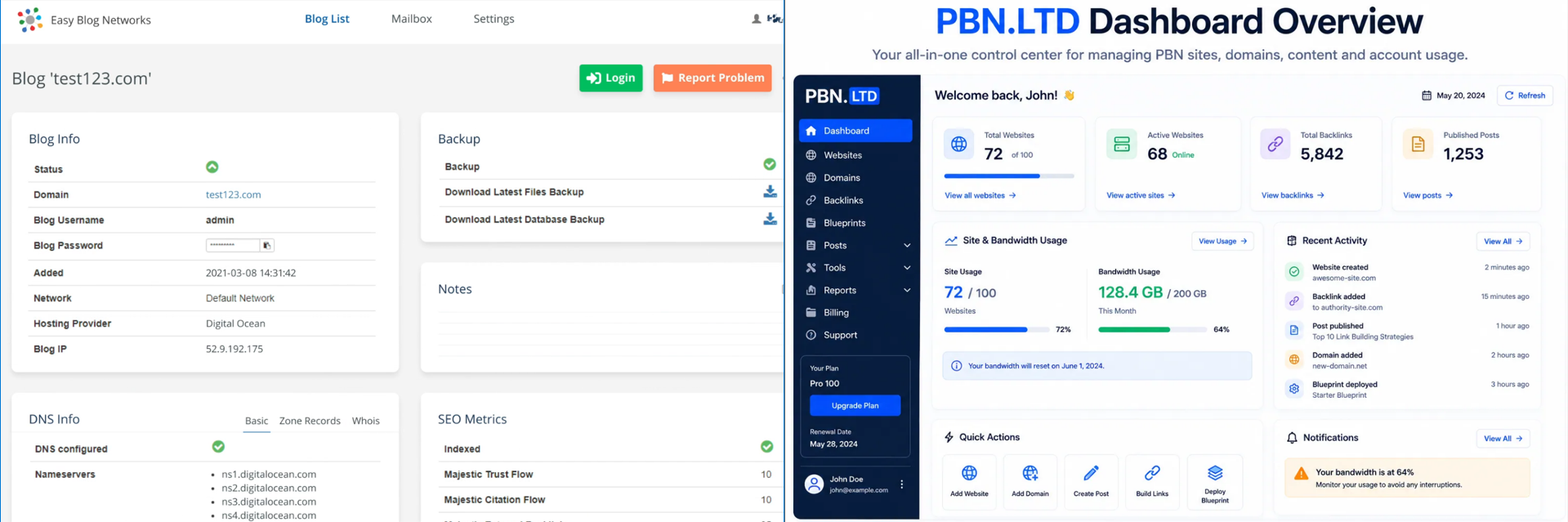
Image Source: Easyblog and PBN LTD
I see the main difference as managed WordPress automation versus lower entry pricing combined with more hands-on control. The right model depends on whether reducing administration or retaining flexibility is my bigger priority.
EBN handles routine tasks such as WordPress updates, daily backups, SSL and infrastructure allocation through its managed platform. It is WordPress-focused and uses defined resource allocations, with resource-heavy blogs consuming additional plan slots.
PBN LTD also centralises network management, but its browser-based File Manager and phpMyAdmin provide more direct access to individual sites. Its five-site entry package also gives smaller networks a lower initial commitment than EBN’s 10-blog starting tier.
For relatively standard WordPress sites, I would value EBN’s automation. If I expected frequent configuration changes or wanted to minimise initial recurring costs, I would lean towards PBN LTD.
Which Offers Better Pricing and Long-Term Value?
PBN LTD has the lower verified published entry price in the information reviewed, while EBN’s value depends on whether its managed WordPress features save enough administration time to justify the subscription. I would compare the capacity I actually need rather than rely on headline cost per site.
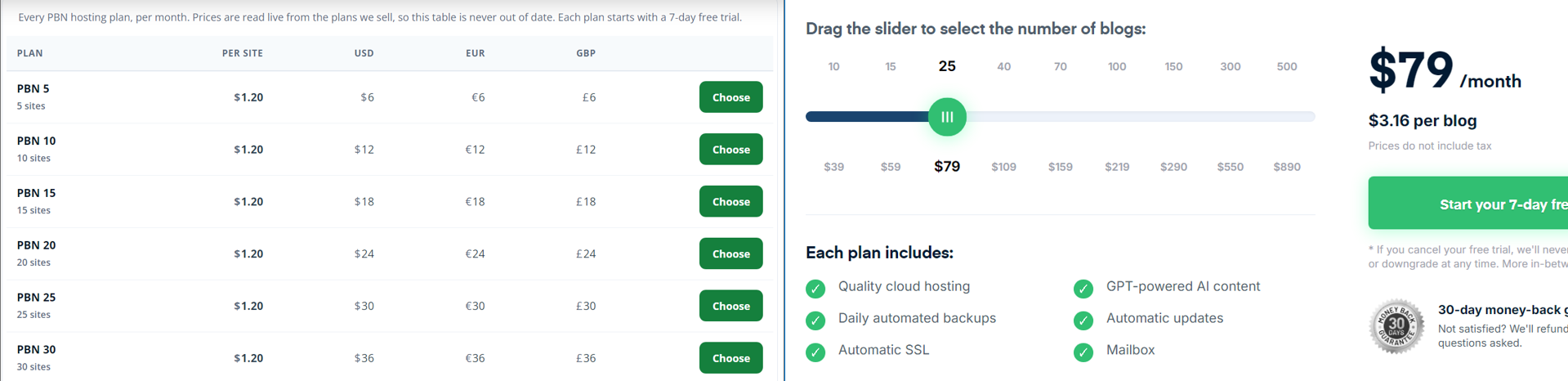
Image Source: Easyblog and PBN LTD
PBN LTD Starts With a Lower Published Commitment
PBN LTD’s published pricing lists five sites for $6 per month, 10 sites for $12, 25 sites for $30 and 50 sites for $60. The smaller package makes it easier to start with a limited network without paying for a 10-blog minimum.
When a package is fully used, these first tiers work out to $1.20 per available site per month. The practical value still depends on how many slots I use and whether I need additional resources or services.
I would verify the current plan and currency before subscribing because published prices and package terms can change.
EBN’s Value Includes Managed WordPress Administration
EBN’s plan selector starts at 10 blogs. Its current pricing page should be checked directly for the applicable subscription price rather than relying on older figures.
The platform advertises daily backups, automated updates, SSL and infrastructure allocation. Resource-heavy blogs can use double or triple resource allocations, but these consume two or three plan slots respectively.
That makes a simple per-site price comparison incomplete. PBN LTD is easier to favour on published entry cost, while EBN may justify a higher total expense when its automation replaces work I would otherwise handle manually.
How Do Their Hosting Infrastructure and Footprint Management Compare?
Both providers promote infrastructure diversity to reduce obvious common hosting signals. I would compare what each documents rather than treat “zero footprint” or similar marketing claims as proof that a network cannot be identified.
EBN Distributes Sites Across Different Infrastructure
EBN says its blogs are distributed across different A-, B- and C-block IP ranges, data centres, hosting companies and DNS arrangements. It manages that distribution through a central dashboard, reducing the need for me to administer numerous separate hosting accounts.
Its published information names providers including AWS, Rackspace, DigitalOcean and IBM Cloud as examples from its hosting pool. EBN also advertises automated nameserver configuration.
The practical advantage is reduced infrastructure administration. However, infrastructure diversity alone does not establish that other similarities between sites cannot reveal a connection.
PBN LTD Automates Multiple Infrastructure Variables
PBN LTD documents a dynamic IP pool, multiple hosting and DNS providers, and automated infrastructure variation. It also advertises management of numerous footprint variables. I would treat the exact scope and effectiveness of those claims as provider representations unless independently verified.
This model may appeal to operators who want centralised infrastructure variation without adopting EBN’s specific managed WordPress approach.
Hosting is only one source of potential commonality. Site configurations, content patterns, ownership signals and linking behaviour can also matter. I therefore treat infrastructure as one selection factor rather than the deciding factor.
Understanding the differences between PBN hosting and shared hosting can also help clarify how hosting arrangements differ in infrastructure, management and resource allocation. I would use those distinctions alongside each provider’s documented features rather than assume that one hosting model automatically guarantees better results.
My distinction is straightforward: EBN emphasises managed distribution across hosting providers, while PBN LTD combines infrastructure variation with a lower published starting price and more direct site-level tools.
Which Is Easier for Managing WordPress PBNs?
EBN is stronger when I want routine WordPress maintenance automated. PBN LTD is more appealing when I need direct access to individual site files, databases and configurations.
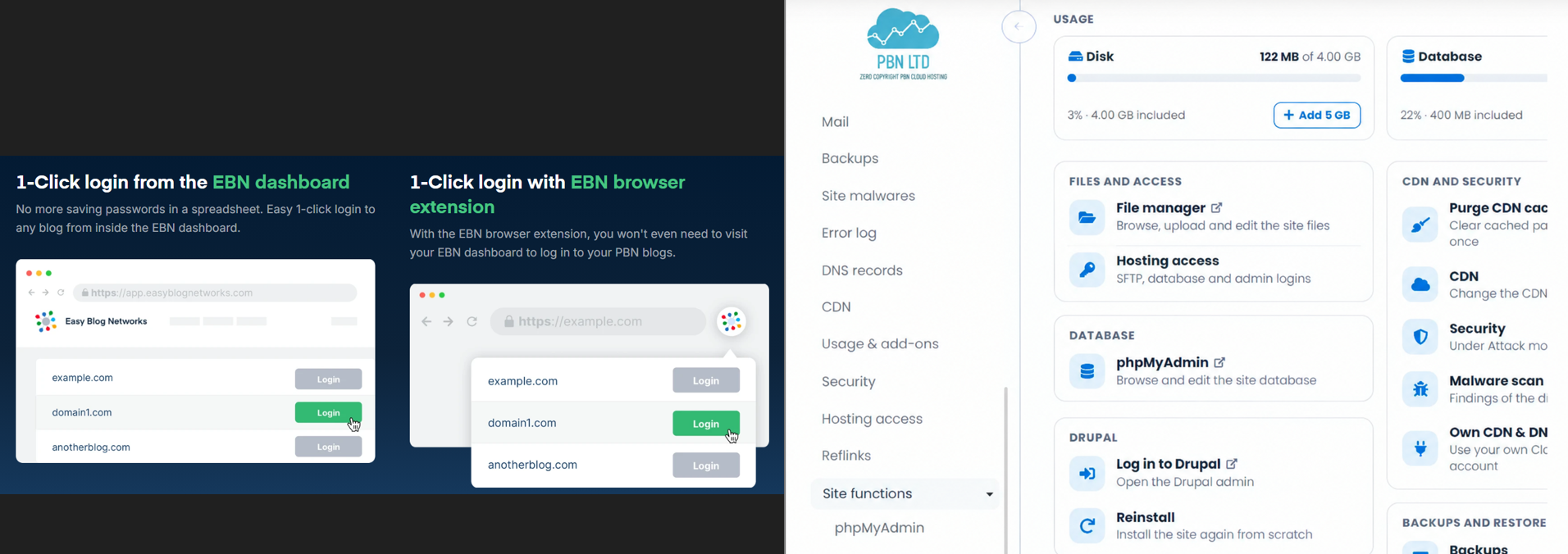
Image Source: Easyblog and PBN LTD
EBN Prioritises WordPress Automation
EBN centralises WordPress deployment, updates, daily backups and other routine maintenance. Its main advantage, in my view, is reducing repetitive work across a network rather than providing unrestricted server-level control.
The platform also supports centralised site management, including quick logins and collaborator access. For standard WordPress installations, that managed approach becomes more valuable as the number of sites grows.
PBN LTD Provides More Direct Management Tools
PBN LTD provides browser-based File Manager and phpMyAdmin access. These tools are useful when I need to modify files, inspect databases or troubleshoot individual installations without relying entirely on a managed workflow.
The platform also documents per-site PHP selection and bulk WordPress operations. Those options give it an advantage for networks where individual sites need more frequent intervention.
I would choose EBN for convenience and routine automation. I would favour PBN LTD when hands-on site management is a regular requirement.
What Restrictions and Management Trade-Offs Should You Know About?
EBN operates within a more controlled environment, while PBN LTD provides direct file and database access. I would check the requirements of my most demanding sites before choosing either service.
EBN’s Managed Environment Has Defined Limits
EBN uses resource allocations that can require additional blog slots when sites need double or triple resources. This can increase the effective cost of hosting a network containing several resource-heavy installations.
Some historical feedback supplied for this comparison raised concerns about memory, code editing and plugin restrictions. I could not verify several of those claims as current 2026 rules, so I would not present them as established current limitations.
EBN does document restrictions affecting certain migration or cloning plugins that may interfere with its platform. If my workflow depends on a specialised plugin, I would confirm compatibility before moving sites.
PBN LTD Offers Direct Access Without Standard FTP or SSH
PBN LTD’s standard PBN hosting does not provide FTP or SSH access, but its File Manager and phpMyAdmin tools allow direct file and database work. For me, this provides a useful middle ground between a tightly managed platform and unrestricted server access.
The File Manager supports tasks such as editing wp-config.php and .htaccess, while phpMyAdmin allows database access and exports. PBN LTD also states that it does not block WordPress plugins; I would verify any plugin-specific requirements before committing.
I would lean towards EBN for straightforward sites where automated maintenance is the priority. PBN LTD has the clearer advantage when frequent file, database or configuration changes are part of my workflow.
Which Is Better for Performance, Reliability and Backups?
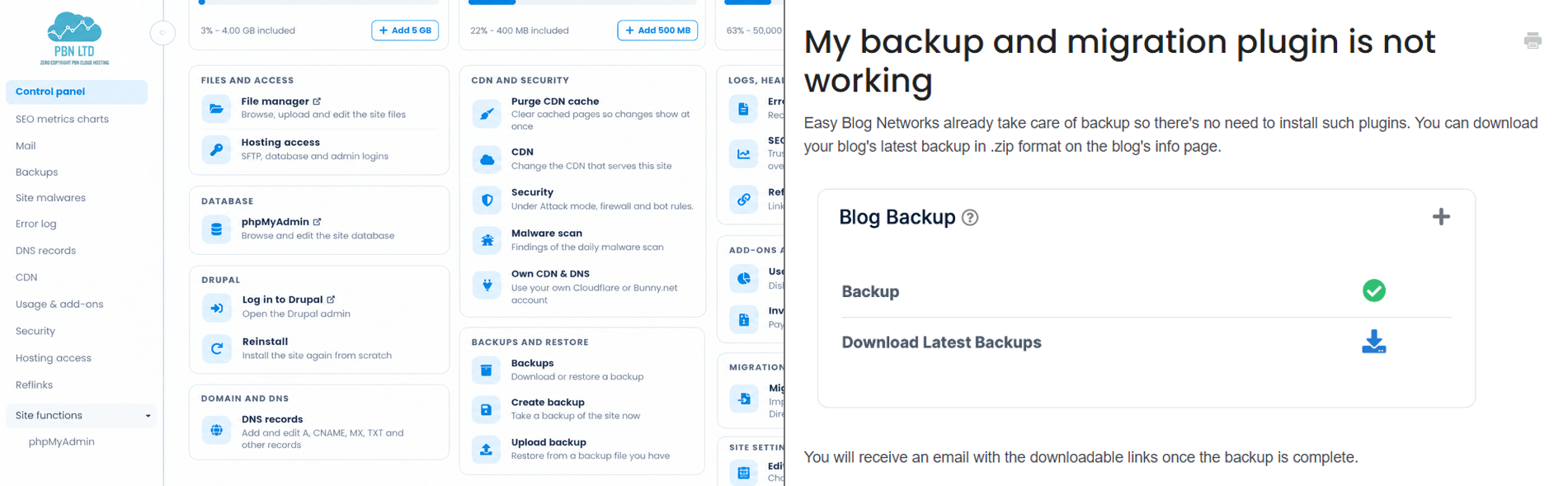
Image Source: Easyblog and PBN LTD
Both providers support site migrations, but PBN LTD documents two routes: self-service migration and free, provider-assisted migration for eligible paying customers. Its migration guide explains that the self-service process lets me keep the existing site running until I switch the domain’s nameservers. Provider-assisted migration requires an active paid subscription and enough available site slots.
I would also keep independent backups rather than rely solely on the hosting account: PBN LTD’s terms state that data associated with an unpaid account is permanently deleted after the specified post-expiry period if the account remains unpaid. For me, the key comparison is how much migration work each provider handles, the eligibility conditions and how easily I can retain my own backups.
Before switching, I would check the current migration instructions and keep an independent copy of the site’s files and database.
How Do Migrations Compare?
Both providers advertise automated backups, but I would not treat either service’s backup system as a substitute for maintaining my own copies. PBN LTD’s pricing page lists daily backups retained for 30 days and one-click restoration. Its terms clarify that backups are provided as a convenience, can be incomplete or fail, and may be deleted after the retention period. Customers are responsible for keeping their own up-to-date copies off the platform.
For me, the practical comparison is not simply whether daily backups exist. I would also check retention, restoration options and how easily I can download a backup before relying on either provider for a critical network.
Which Platform Scales Better as Your Network Grows?
Both platforms support larger networks, but PBN LTD’s published site-count tiers make capacity costs easier to estimate. EBN’s scaling model is more closely tied to its managed approach and the number of slots consumed by resource-heavy blogs.
PBN LTD offers multiple package sizes, allowing me to estimate hosting expenditure as a network grows. EBN can also scale beyond its 10-blog entry point, although blogs using double or triple resources consume additional slots.
I would favour PBN LTD when predictable package costs and direct control matter most. EBN makes more sense when reducing routine administration across a growing WordPress network justifies the managed model.
How Does Support Compare?
Both providers offer support for their platforms, but I do not have comparable independent response-time evidence to rank their support quality. I would judge this factor by the assistance each service documents and the help available for my specific requirements.
EBN documents platform and migration support, while its managed environment reduces some tasks that would otherwise require manual troubleshooting. PBN LTD also provides platform support and advertises managed migration for qualifying networks.
Neither gives me enough comparable evidence to declare superior support responsiveness. I would check current support channels, availability and migration terms before making the final decision.
Easy Blog Networks Pros and Cons
EBN’s strengths centre on WordPress automation and managed infrastructure distribution. The trade-off is accepting a more controlled environment and a resource model that can affect total cost.
Pros
- Automated WordPress maintenance and daily backups.
- Multi-provider hosting distribution.
- Centralised site management that reduces infrastructure administration.
- Free incoming transfers advertised by the provider.
Cons
- A 10-blog starting tier.
- Defined resource allocations, with additional slots needed for higher resource use.
- Less direct file and database control than PBN LTD.
- Some plugin and migration workflows require compatibility checks.
PBN LTD Pros and Cons
PBN LTD combines a low published entry cost with direct site-management tools. Its main compromise is that operators who prefer a more automated WordPress maintenance experience may find EBN more convenient.
Pros
- Published five-site entry plan at $6 per month.
- Direct File Manager and database access.
- Multiple package sizes for network growth.
- Daily backups with restore and download options.
Cons
- No standard FTP or SSH access on its PBN hosting.
- Some managed migration services have eligibility conditions.
- More direct control may mean more hands-on work for routine site-level tasks.
Final Verdict: Which Should You Choose?
I would choose Easy Blog Networks when automated WordPress maintenance and managed infrastructure distribution matter more than maximum direct control. I would choose PBN LTD when lower published entry costs, flexible capacity and direct file or database access are higher priorities.
EBN makes the stronger case for relatively standard WordPress networks where reduced routine administration justifies its managed environment and resource-based slot consumption. PBN LTD is more compelling when I want a lower starting commitment or expect to intervene directly in individual sites.
I would make the final decision around the requirements that are hardest to change later: recurring cost, access needs, resource allocation and management workflow. Neither provider’s footprint claims would determine my choice on their own.
Frequently Asked Questions
Is Easy Blog Networks more expensive than PBN LTD?
PBN LTD’s published entry plan is $6 per month for five sites. EBN starts at 10 blogs, but I would check its current live price before making an exact cost comparison.
Can I migrate a PBN from Easy Blog Networks to PBN LTD?
EBN provides a way to download backups, while PBN LTD advertises managed switching for qualifying networks. Check the latest migration documentation and eligibility conditions before transferring sites.
Does Easy Blog Networks prevent hosting footprints?
EBN distributes sites across different IP ranges, hosting providers, data centres and DNS arrangements to reduce obvious infrastructure commonality. This does not guarantee that a network cannot be identified through other signals.
How does PBN LTD manage IP and DNS diversity?
PBN LTD documents multiple hosting and DNS providers, a dynamic IP pool and automated infrastructure variation. Its claims about footprint reduction should be assessed as provider claims rather than proof of undetectability.
Can I manage WordPress sites from one dashboard with both platforms?
Yes. Both centralise site management, although their approaches differ. EBN emphasises automated WordPress maintenance, while PBN LTD combines central management with direct file and database tools.
What should I look for when choosing PBN hosting?
I would compare recurring cost, infrastructure, resource limits, WordPress control, backups, migration portability and how much routine administration the platform removes. I would also verify current restrictions before moving an existing network.
Is managed PBN hosting worth paying for?
It can be worthwhile when centralised maintenance saves enough time across multiple sites. If I already have an efficient management workflow, a lower-cost option with sufficient control may offer better value.