
TL;DR
PBN hosting for SEO can centralise the management of multiple websites, but it does not improve rankings or make manipulative links safe. Before choosing a provider, I would examine its infrastructure, per-site resources, security isolation, backup recovery, access restrictions and total cost rather than accept claims such as “zero footprints” at face value.
Different IP addresses, nameservers, hosting companies or CDN endpoints may change observable infrastructure. None guarantees indexation, prevents detection or protects a network from search-engine action.
PBN hosting is generally aimed at people managing multiple websites through one service. Its practical appeal is convenience: a provider may combine deployment, WordPress maintenance, SSL, DNS configuration, backups and monitoring in one dashboard.
That convenience needs to be evaluated separately from the network’s purpose. Links created primarily to manipulate rankings can violate search-engine policies regardless of the hosting arrangement. For background, see what PBN SEO means. This guide focuses on what a provider demonstrably offers, what hosting can influence and what I would verify before paying.
What Is PBN Hosting for SEO?
PBN hosting is a specialist hosting arrangement designed to manage a collection of websites while offering some variation in their technical infrastructure. It is not a ranking system recognised or endorsed by search engines.
Implementations differ. One service may distribute sites across several upstream hosting companies, while another uses multiple servers, IP addresses or DNS configurations. A CDN-based service may expose CDN edge addresses to visitors and crawlers while keeping the origin server elsewhere.
Managed services may also install WordPress, apply updates, issue SSL certificates, schedule backups and provide centralised access. These functions can reduce administration, but terms such as “managed”, “diverse” and “CDN hosted” are not standardised. I would judge each service by its disclosed architecture, limits and controls.
What Can PBN Hosting Influence and What Can’t It Do?
Hosting can influence availability, response performance, security and administrative efficiency. It cannot guarantee rankings, indexing, legitimate backlinks, anonymity or protection from search-engine action.
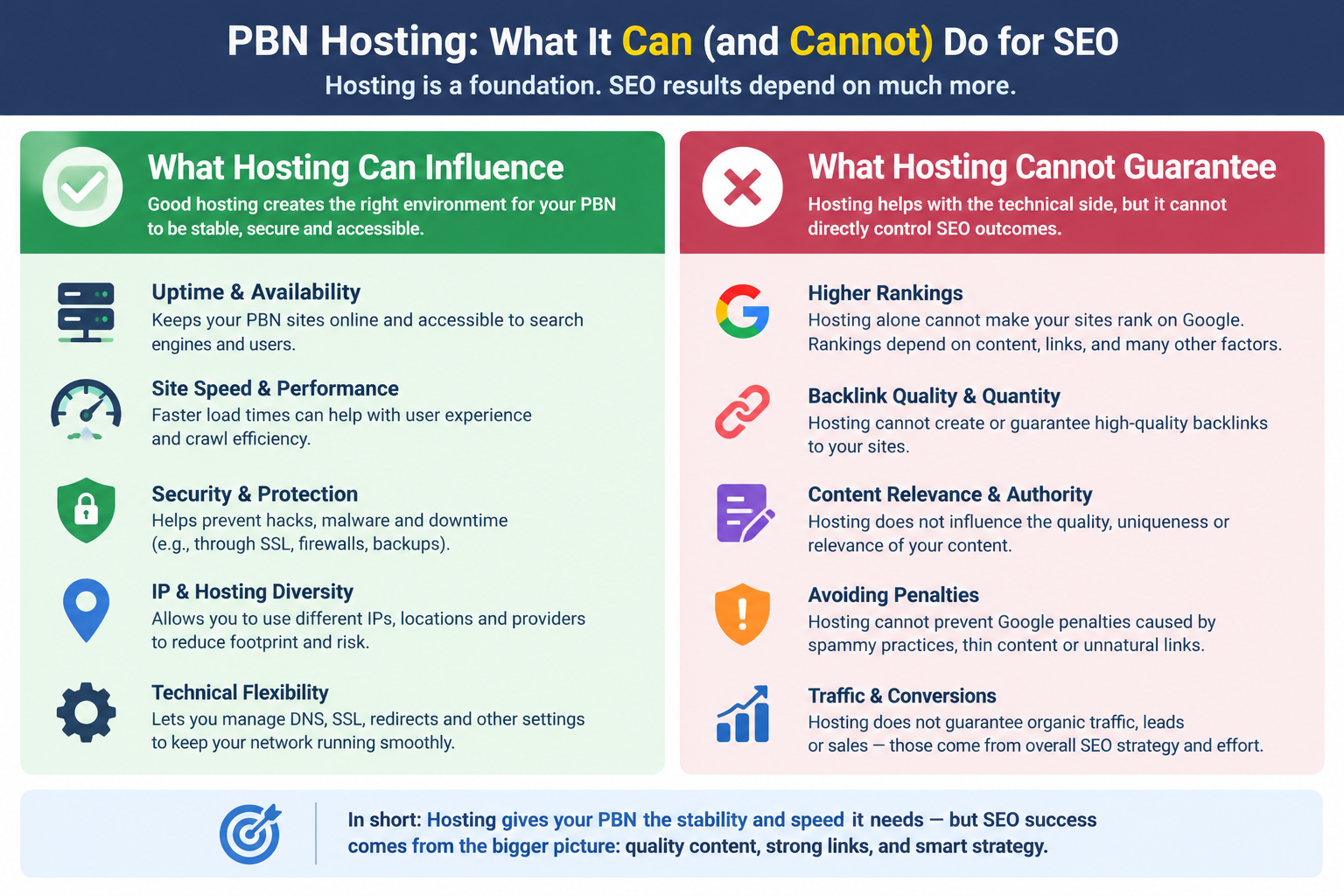
Adequate resources and reliable delivery help keep pages accessible. Performance can contribute to user experience, and Google uses Core Web Vitals within its broader ranking systems. However, good performance does not guarantee prominent rankings, and changing an IP address does not make content more relevant or links more deserving of ranking credit.
A CDN may improve delivery and help a site handle more requests, depending on its configuration. Google’s crawling guidance discusses how CDN-backed sites may affect crawl capacity; this should not be interpreted as evidence of a ranking boost or a guarantee that the origin is concealed.
The greater limitation concerns purpose. Google classifies links created primarily to manipulate rankings as link spam, while Bing’s webmaster guidance identifies private networks among artificial linking schemes. Different IPs, nameservers or server locations do not change the intent behind a link.
I would therefore treat claims such as “undetectable”, “zero-footprint” and “safe from penalties” as marketing claims, not verifiable outcomes. Infrastructure variation cannot remove every relationship between sites or eliminate algorithmic and manual enforcement risk.
What Should You Evaluate Before Choosing a PBN Hosting Provider?
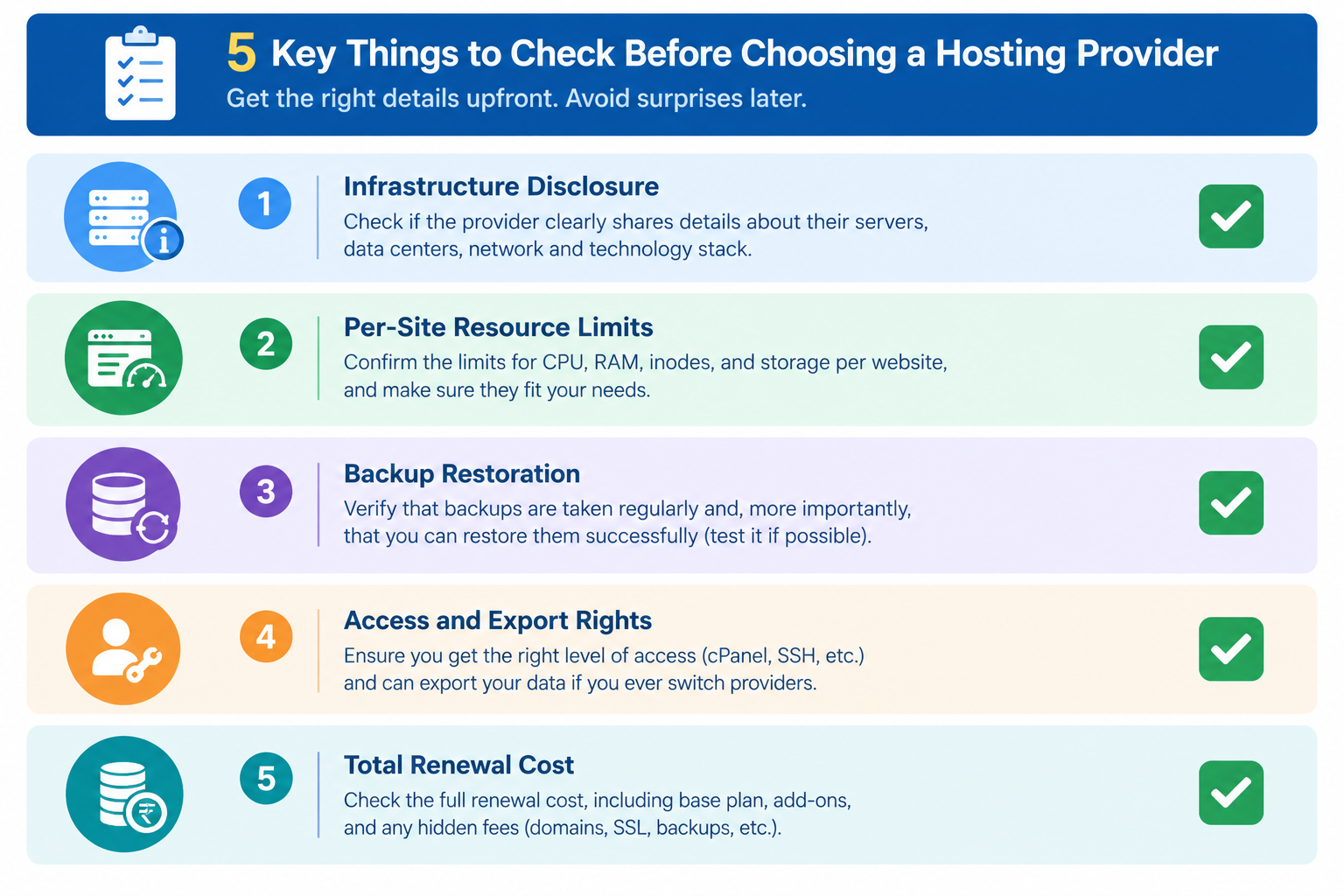
The most useful evaluation goes beyond counting IP addresses. I would examine how infrastructure is supplied, what resources each site receives, how failures are contained and whether the network can be recovered or moved without depending permanently on one provider.
Infrastructure, IP and DNS Arrangements
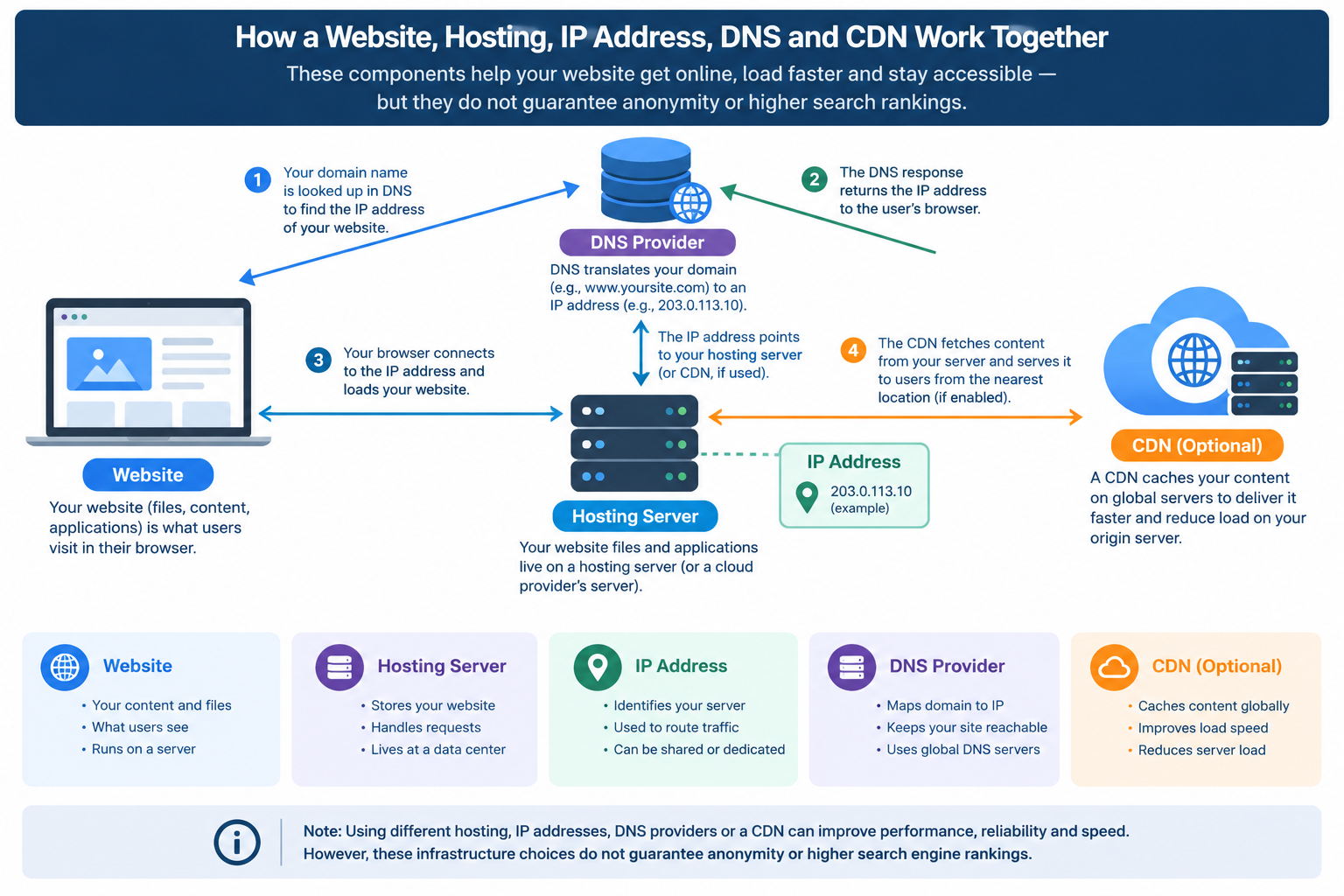
Ask what terms such as “multiple IPs”, “different providers” and “DNS diversity” actually mean. These descriptions identify technical arrangements, but they do not establish that sites are unrelated or protected from detection.
Find out whether addresses come from genuinely different upstream networks or one operator’s infrastructure, and whether they are dedicated, shared or supplied through a CDN. A unique address is not automatically higher quality, while a shared address does not make all sites equivalent.
For CDN-based plans, establish whether the service supports a complete dynamic WordPress installation or only delivers static content. Ask how the origin is protected and what happens if the CDN is bypassed or unavailable.
Nameserver variation changes visible DNS records, but it is only one technical detail. I would not pay extra for arbitrary server locations unless they support the sites’ audiences, performance or legal requirements. Geographical variety alone is not a ranking advantage.
Resources, Performance and Site Isolation
Verify the resources available to each website and how the provider contains security or performance problems. A generous account-wide allowance can still be restrictive if sites compete for the same CPU, memory or concurrent processes.
Check whether storage, bandwidth, database size, inode, CPU and memory limits apply per site or across the account. Ask what happens when a site receives unusual traffic or exceeds a limit: throttling, overage charges and suspension have different operational consequences.
Uptime guarantees need a defined measurement method and remedy. I would test representative sites with independent monitoring rather than infer performance from server software or marketing labels.
Site isolation matters because an outdated plugin or compromised login on one installation should not expose every other site. Confirm whether sites use separated containers, file permissions or accounts, and whether malware scanning and remediation are included.
Management, Backups, Migration and Control
Managed hosting is valuable when its responsibilities are explicit and it does not prevent you from recovering or moving your sites.
Check which WordPress, theme and plugin updates are automatic, whether failed updates can be rolled back, and whether plugins, cron jobs, caching tools or email functions are restricted. Automation reduces repetitive administration, but without staging or rollback controls, a faulty update may affect multiple sites.
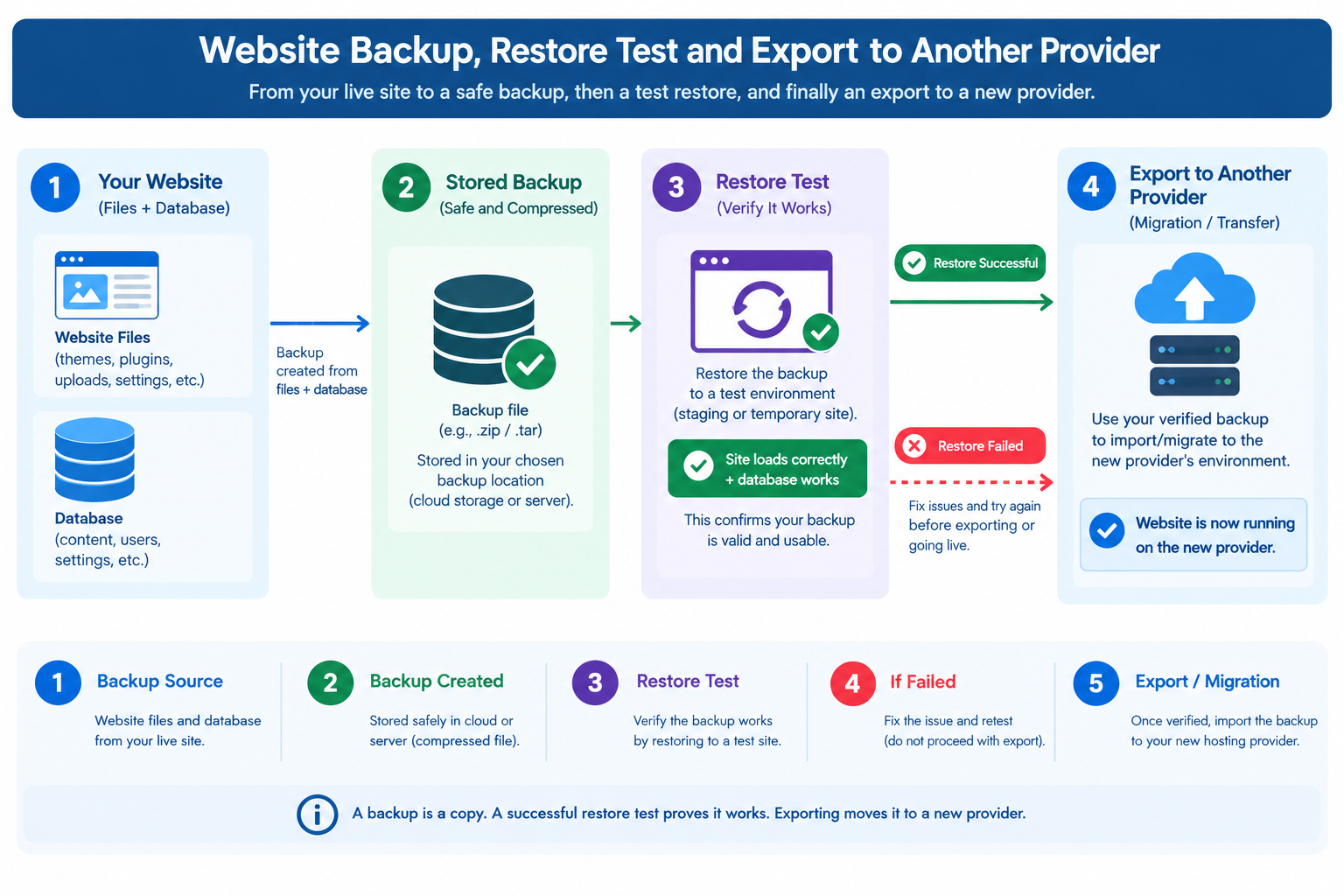
A statement such as “daily backups” is incomplete. Verify retention, storage location, backup timing, restore charges and whether backups cover both files and databases. I would favour a service that lets me download independent copies and perform or request a test restoration.
For migrations, ask what the provider transfers, who corrects errors and how DNS changes and downtime are handled. Confirm access to SFTP, databases, DNS records and relevant logs, along with an export method that does not require an ongoing subscription. If cancellation or suspension makes backups inaccessible, recovery becomes a significant risk.
Support, Restrictions and Scalability
Support quality depends on useful resolution and clear escalation, not simply a “24/7” badge. Scaling must also remain manageable and affordable at your expected number of active sites.
Review support channels, technical scope and escalation procedures before an emergency. Read the acceptable-use and resource policies for prohibited content, traffic limits, suspension triggers and notice periods.
Confirm minimum commitments, maximum site counts and how new sites are allocated. Bulk installation, monitoring and updates can save time, but I would retain site-level controls and independent records rather than rely entirely on one dashboard.
How Should You Verify PBN Hosting Claims?
Translate every broad promise into a technical question. A feature can be genuine while the outcome implied by its marketing remains unproven.
| Provider claim | What it may establish | What it does not prove | What to verify |
|---|---|---|---|
| Multiple IPs or providers | Some infrastructure variation | Safety or non-detection | Allocation method and upstream networks |
| CDN hosting | CDN delivery and edge addresses | A concealed origin or higher rankings | Origin setup and dynamic-site support |
| Automatic backups | Scheduled backup creation | Successful recovery | Retention, download access and test restores |
| Managed hosting | Centralised administration | Full access or unrestricted use | Included tasks, exclusions and controls |
| “Zero footprints” | The provider’s intended configuration | Anonymity or protection from enforcement | Specific architecture and contractual limits |
Ask for documentation where possible and keep answers obtained before purchase. I would be cautious if a provider will not explain resource allocation, backup recovery, access rights or cancellation procedures, even if it reasonably withholds security-sensitive infrastructure details.
A trial can help verify the dashboard, access and workflow, but it cannot demonstrate that a network is undetectable. Test measurable functions instead: deploy a non-critical site, inspect DNS and access controls, download a backup, request a restoration and confirm that an export works.
How Should You Calculate the Real Cost of PBN Hosting?
Calculate the cost at your expected number of active sites, including operational and exit costs. The lowest advertised per-site price may require a larger plan or longer commitment than you need.
Divide the recurring charge by the number of sites you will actually use, not the plan’s maximum capacity. Include renewal rates, taxes, resource overages, premium backups, migrations, SSL, security work and paid support where applicable.
Account for management time as well. A central dashboard may justify a higher fee if it reliably reduces maintenance, but restricted access or difficult exports can create migration costs later. I would compare monthly, annual and cancellation scenarios before committing.
If you are ready to compare individual services after defining your requirements, see our guide to PBN hosting providers. Treat provider features and marketing promises as claims to verify against your own needs.
Conclusion: What I Would Prioritise Before Choosing PBN Hosting for SEO
Before choosing PBN hosting for SEO, I would prioritise transparent infrastructure, adequate per-site resources, strong site isolation, recoverable backups and the freedom to export every website.
I would also require clear restrictions, realistic support terms and a sustainable cost at the intended network size. IP, DNS and provider variation may change technical arrangements, but none guarantees rankings, indexation or non-detection. The right choice is not necessarily a universally “best” host; it is the service whose measurable capabilities, limitations and exit options match the workload.
Frequently Asked Questions
Is PBN hosting illegal?
PBN hosting is not inherently illegal; it is a technical service for hosting multiple websites. However, activities conducted through those sites may create contractual, intellectual-property or other legal issues, while links created primarily to manipulate rankings can violate search-engine policies.
Does PBN hosting improve Google rankings?
No. PBN hosting does not provide an inherent ranking advantage. Hosting quality can support availability, performance and crawling, but rankings depend on broader factors, and manipulative links remain subject to Google’s spam policies.
Can Google detect websites hosted on different IP addresses?
Different IP addresses do not make detection impossible. Search engines can evaluate many technical, content and linking signals, and Google does not disclose every method used to identify policy violations.
Is CDN hosting suitable for a WordPress PBN?
It can be, but the implementation matters. Verify whether the service supports dynamic WordPress functions, database access, caching exclusions, updates and origin security rather than assuming every CDN-based plan provides conventional WordPress hosting.
How many PBN websites can share one IP address?
There is no official Google rule requiring one site per IP address. Multiple unrelated websites commonly share IPs, while assigning every site a different address does not prove independence or guarantee protection from detection.
What access should a PBN hosting provider give me?
I would look for access to site files, databases, DNS records, backups and relevant logs. Confirm that you can export complete working copies without maintaining the subscription and that any restrictions are disclosed before purchase.
Can I move my sites if I leave a PBN hosting provider?
That depends on the provider’s export tools, access controls and cancellation policy. Before subscribing, verify that files, databases and backups are downloadable, and establish whether migration assistance, notice periods or additional fees apply.